This blog is inspired by a blog post from PhDemi, where she says that in order for her research to be useful, it must be understandable – and I couldn’t agree more! Much of academia is inaccessible to the general population because its hidden away behind walls of unnecessarily confusing language. Not only does this put people off of academia altogether, it also limits the impact that research can have. I believe that in order for research to have the biggest impact, it must reach as many people as possible. You never know who might stumble across your work and see its value! So with that in mind, I wanted to have a go at using Demi’s blog format to try and explain my PhD in simple terms.
In simple terms
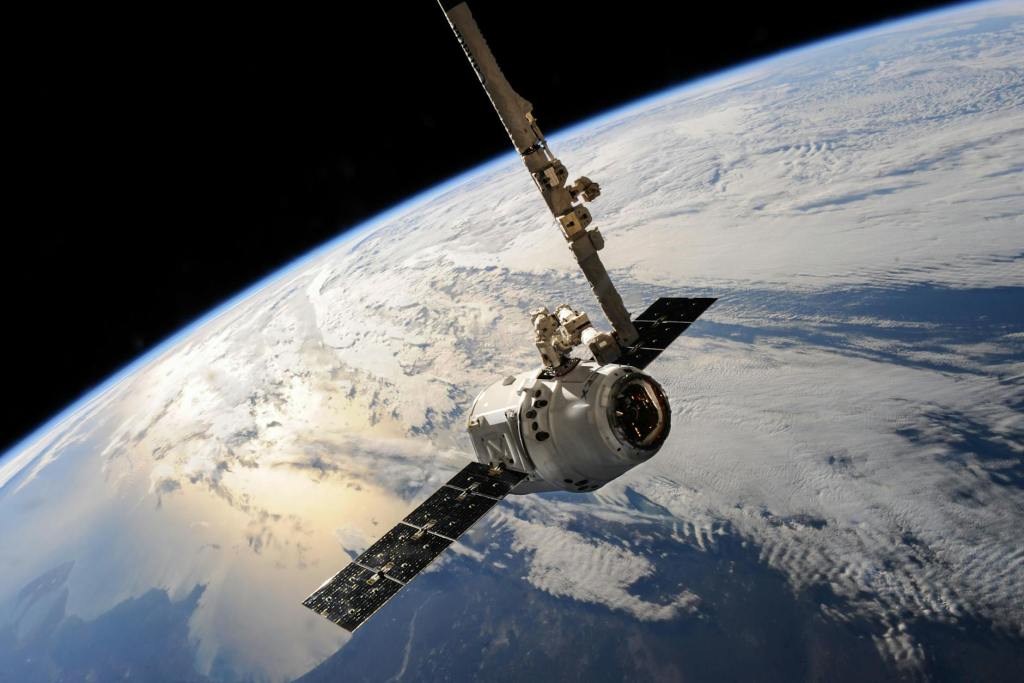
The title of my PhD is ‘A Decentralised Autonomous Community in Space‘. Each year, hundreds of satellites are launched into space, and most of them end up in a region known as Low Earth Orbit (LEO), which is the region I am interested in. LEO ranges from around 160km to 2000km above the Earth’s surface. This is where you find iconic missions like the International Space Station and huge constellations like Starlink.
Imagine a busy motorway during rush hour. Now imagine that motorway is filling up with thousands of non-stop-driving cars, all moving at thousands of miles per hour. That’s LEO right now. The rapid increase in launches is causing congestion, leading to a much higher risk of dangerous collisions, and creating a massive headache for everyone involved.
When a motorway gets congested, humans step in: a Traffic Control Centre opens an extra lane or changes the speed limit. Satellite operators do the same. If a crash risk is detected, they use ground stations (giant radio dishes) to manually send instructions to the threatened satellites, telling them to change their path (or “orbit”).
The problem is that this entire process is slow, reactive, and centralised:
- Slow: It takes time for an operator to assess the risk, make a decision, and transmit the instruction.
- Centralised: If that single Ground Station or Control Centre has a technical fault, is attacked, or is simply overwhelmed, the entire system is paralysed. Think of it as one weak point that puts thousands of satellites at risk of catastrophe.
This is where my PhD comes in. I’m building the foundation for a decentralised system in space.
Instead of having a single, vulnerable Control Centre, I am researching how to create a community where every single satellite takes responsibility for its own actions and operations.
This approach offers two huge advantages for LEO:
- Faster: Each satellite becomes autonomous. They can make instant, collision-avoiding decisions based on the real-time information they collect from their neighbours, without waiting for slow human instructions.
- Safer: The system is more resilient. To disrupt the community, you’d need to take down a majority of satellites, not just one Ground Station. The failure of one satellite doesn’t cause a traffic jam for everyone else.
My research is about designing the rules, communications, and decision-making logic for this self-governing cosmic community. It’s about building a safer, faster, and more robust way to manage the future of space.
So, what am I actually doing?
I’ve divided my PhD is into three main stages:
Stage One (Completed): Figuring out what special rules (or ‘requirements’) a technology needs to follow to work reliably in space, and seeing what’s currently missing in existing tech.
Stage Two (Current): This is the core of my work right now. I’m designing and building a piece of software that helps satellites decide which sensor data (like where they are or where they should go) is valid and safe to use, and which isn’t.
Stage Three (Future): I’ll be testing my software on real electronics hardware and in real-world scenarios to make sure it’s robust and dependable.
In practical terms, my research life is a lively mix of activities:
- Learning: I read a lot of other people’s research to stay current and improve my own understanding.
- Coding: I spend a lot of time developing the prototype software using Python.
- Analysis: I use mathematics to design, model, and analyse the algorithms that power the trust system.
- Collaboration: I constantly present my findings to different groups, from satellite companies and electronics engineers to other academics, to get expert feedback and inspiration. I do this through writing formal research papers and giving presentations at conferences.
What’s coming up?
Things are moving quickly! In April, I’ll be moving into the challenging but exciting third year of my PhD (eek!).
- January 2026: I’m aiming to finish the first version of my software prototype and present it at the SciTech conference in Florida.
- Early-Mid 2026: I’ll be taking on board any feedback to improve the software’s performance, and then writing up those findings into a new research paper. I’ve also applied to a couple more conferences later in the year (wish me luck!).
- Ongoing: I’ll be spending some time teaching undergraduate students in electronics labs, which is a great way to reinforce my own knowledge.
- Late 2026: I hope to officially kick off Phase Three, where I’ll get my hands on the electronics hardware to see how well my software performs in a more realistic environment.
All-in-all, there are a lot of fun and interesting things for me to look forward to!


 She Codes the Cosmos
Leave a reply to gavigne@gmail.com Cancel reply