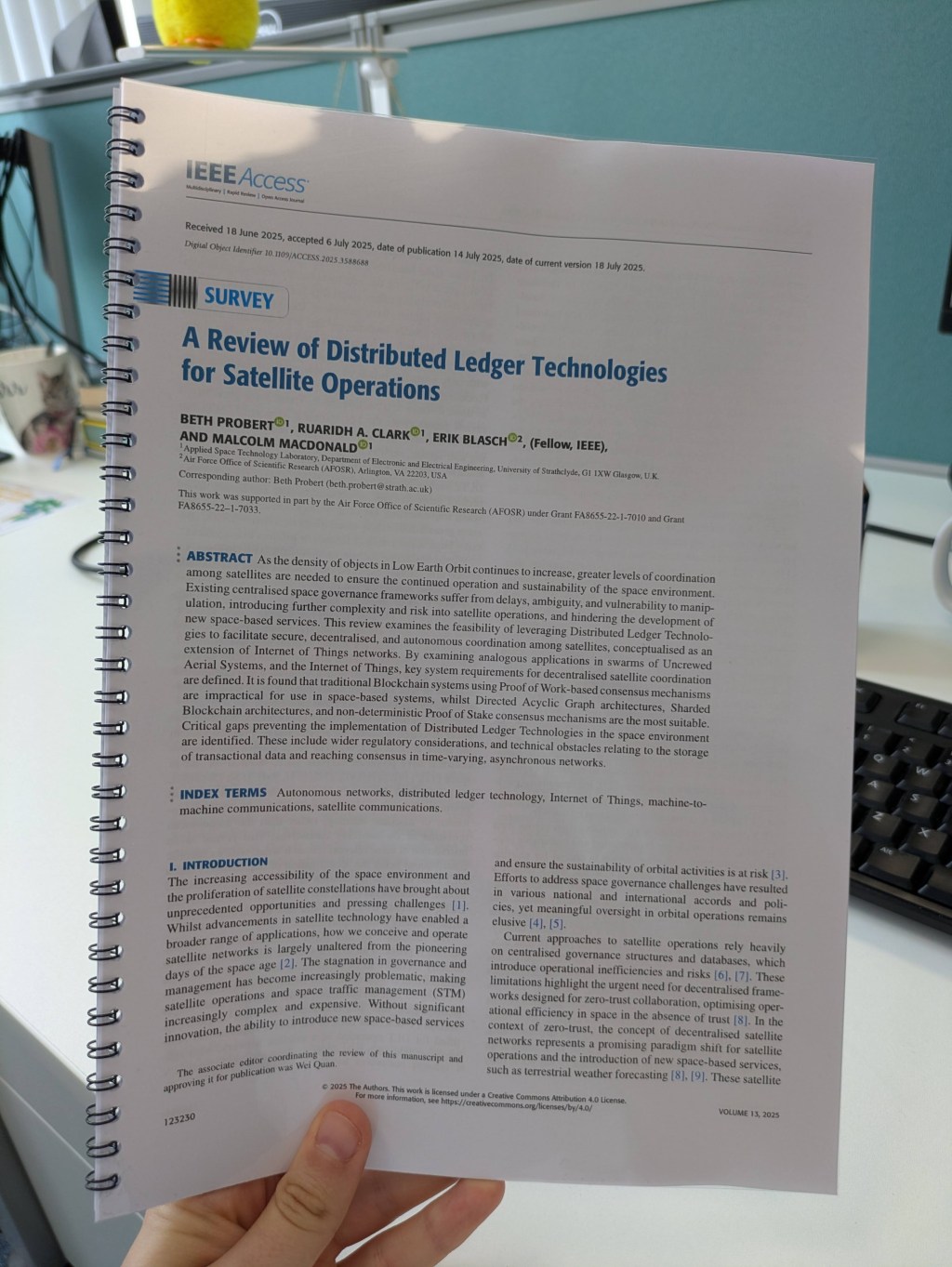
I’ve recently reached a huge milestone in my PhD journey: publishing my first-ever first-author paper in an academic journal. For many academics, seeing your research in print is a proud and defining moment, and I can confirm it feels every bit as rewarding as I’d hoped. The journey to get there isn’t always straightforward, and it certainly pushed me out of my comfort zone, but it was an incredible learning experience. Now that I’m on the other side, I want to share my experience of getting published and some advice for anyone aiming to see their own work in a journal.
For anyone interested, my paper ‘A Review of Distributed Ledger Technologies for Satellite Operations’ is available to read Open Access at: https://ieeexplore.ieee.org/document/11079570
What does “getting published” actually mean?
Let’s skip back to my opening sentence: “…publishing my first-ever first-author paper in an academic journal“, and break down a few of those points.
A paper is an article, usually written in a formal, academic style, describing your research. It contains information about a specific contribution from your work, such as a key result, a new method, or some other kind of analysis.
- There are a few different kinds of papers that you can write. These include:
- Research articles, which have an experiment or result that adds value to the academic community
- Survey articles, which present fresh conclusions from a large number of recently published scholarly articles. (My article is a survey)
- Mathematical theory papers
- and more! Some examples can be found here.
An academic journal is a publication that contains papers. There are thousands of journals out there, each with different specialisms and amounts of notoriety. A famous example of a journal is Nature, which has a reputation for publishing prestigious work. For context, my paper (linked above) was published in the IEEE Access journal. Journals can come in digital and print formats, and usually have regular publishing schedules, similar to magazines.
- Journals will have teams of editors and reviewers who are responsible for assessing submitted papers and considering them for publication. Each submitted paper will be assessed by a team of at least two reviewers in a process known as peer review. These reviewers will be experts in fields relevant to the submitted paper.
- The peer review process is what makes publication in a journal such a milestone. When your work is accepted for publication in a journal, it means that experts in your field agree that your work is worthy of merit and contributing to the knowledge of your field. This process is incredibly rigorous and is the hardest part of the publishing process to get through. Peer review is what sets the standard for research to be published, so the reviewers will assess and critique everything from your writing style to your methodology, analysis of your results, and the quality of your references. Getting through peer review is a big deal!
- Journals can publish papers in two ways: open access or closed access. Open access means that anyone can read your paper for free, once it’s been published by the journal. Closed access means that in order to read the paper, the reader must pay a fee to the journal, usually in the form of a subscription. Most academic institutions will have journal subscriptions allowing their staff and students to access papers.
Being the first author on your paper means that your name goes first in the list of authors. This is prestigious because it signifies that you led and did a significant amount of the work in both writing the paper and conducting the work that the paper is about. It also means that your name may be the only one used when the paper is cited elsewhere (e.g. Probert et al.)
- It is highly unlikely that you will be the only author on your paper, especially as a PhD student. You will probably have at least two co-authors in the form of your PhD supervisors who should guide you through the paper-writing process and provide feedback on your work. You may have other co-authors who contributed to the paper and/or the research behind it. Guidance on authorship can be found here.
- It is recommended that authors of papers have an ORCiD ID, which is a unique number representing you as a researcher. This is useful because even if your name or where you work changes, your ID number stays the same.
Publishing is the final step in the process for a paper, and means it is finished and ready to be sent out into the world. There are a few steps you go through to get a paper published:
- Drafting: Once you have a piece of work you would like to publish, you will need to draft the paper. This will include having sections such as an Introduction, Discussion and Conclusion (although these sections can change depending on your field, the type of paper you are writing and the journal you hope to publish in).
- Internal Review and Redrafting: Before sending your draft to a journal, its a good idea to have your supervisors and/or co-authors review your paper to check they are happy with its contents and structure.
- Submission: When all authors are happy, you will then need to format your paper according to your chosen journal’s template. They often provide these on their website in Microsoft Word and LaTeX formats. They will also have submission guidelines and checklists for you to follow. Once everything is prepped, you submit your paper, often through an online portal.
- Rework and Resubmission: Your paper will then go through peer review, and it is likely your reviewers will have comments that you need to address before they accept the paper for publication. This rework can take a few iterations, depending on the comments you receive, and is often a longer part of the process. Many journals can take months or over a year to accept a paper once it’s been submitted, so be prepared to wait. You’ll then move on to one of the next two phases.
- Rejection or Withdrawal: Sometimes papers get rejected. It sucks. Your reviewers should explain why they feel your paper isn’t right for this journal, so that you can rework it and submit it elsewhere. You may also decide to withdraw the paper from publication if the reviewers’ comments are too significant. You can appeal a rejection decision with a journal’s editor if you feel the reviewers have been unfair.
- Acceptance and Proofing: Once your paper has been accepted, the journal’s editor will compile a final version for you to proof-read. You may also be asked to upload any figures as separate, high-resolution files ahead of publication and printing. An Early Access version of your paper, without your final proofing checks, may be published on the journal’s website. At this stage, your paper will also be given a unique DOI (Digital Object Identifier), allowing you to cite it elsewhere. At this point, you will also be asked to pay a fee to the journal for publishing your work. This is often expensive (on the scale of hundreds to thousands of pounds), and should be covered by your university.
- Publishing: Once proofing is complete, the final version will be published by the journal! Your work is complete.
My journey, and what I’d tell anyone starting theirs
I knew none of the information above before I set out to write my paper, so to call the experience “daunting” might be an understatement! My journey from first draft to publication took around eight months: I shared my first draft with my supervisors in January 2025, submitted the final draft to the journal in April, received reviewer comments in May, resubmitted in June, and (to my great relief) saw it accepted and published in July. It’s worth remembering that everyone’s journey to publishing is different, and your experience may look very different to mine.
Looking back, I can wholeheartedly say it was worth every late night and re-draft. I learned an enormous amount and am incredibly proud of the final result. For me, this paper represents the entire first year of my PhD – twelve months of reading, networking, analysing, learning, and growing as a researcher. Knowing that my peers, experts in my field, value my work fills me with immense pride.
That said, the process wasn’t without its wobbles. There were moments when I questioned whether I was cut out for writing papers, whether the effort was worth it, and even whether I should simply give up. It was harder than I’d anticipated and, at times, an emotional rollercoaster. The highs were exhilarating; the lows, equally intense. As a researcher, you inevitably become deeply attached to your work, so when the writing isn’t going well, it can feel very personal.
Here are some of the key lessons I learned whilst running the marathon that is writing a paper:
- Prepare, prepare, prepare!
Decide early on the type of paper you’re writing, who your co-authors will be, and which journal you’re aiming for. Research the journal’s formatting requirements and check the associated costs, as publishing fees can vary considerably. Reach out to your supervisors and your institution’s library team as early as possible to see how publishing costs might be covered. Make use of templates if available as they will save you a great deal of time later on. - Get feedback early.
Don’t wait until you have a polished draft to share your work. Seek input from your supervisor and peers at the earliest opportunity. The first review is never the final one, so embrace constructive criticism as part of the process. - Hunker down.
Writing a paper takes longer than you think. Set aside dedicated time and be prepared for a sustained effort. It’s easy to lose momentum, so build writing into your regular schedule. You’ll need to be patient once you’ve submitted the paper too as the road from submission to publishing is often many months long. - Use the tools available.
A good reference tracker will save you hours of frustration. Make the most of built-in features in Word or LaTeX to manage citations, cross-references, and formatting. Automating the fiddly bits lets you focus on the content. - Figures are important.
I spent a lot of time perfecting the figures for my paper. High-quality figures can make your paper far more engaging and easier to understand. Invest time in producing clear, well-labelled visuals: they often communicate your findings more effectively than text alone. - Celebrate!
It can be hard to know when a paper is truly “finished”, but once it’s submitted and then published, take a moment to acknowledge the effort you’ve put in. Whether it’s a quiet coffee or a proper night out, mark the milestone before diving into the next challenge.


Leave a Reply